
Five traditions.
Five angles on the same person.
Each system reads from different inputs and produces a different kind of map. When they're read together, something appears that no single tradition can reach.
Each tradition here is complete on its own terms. A numerology reading produces a real portrait of character and direction. A Vedic chart reveals genuine karmic patterning and timing. A tarot reading surfaces archetypal themes that are active right now. These aren't diminished by being part of a larger reading. They're the same depth, now placed in conversation with each other.
What the integrated reading adds isn't more volume. It's a second kind of seeing: the insight that lives in the relationships between traditions, not inside any one of them alone. When your Life Path number, your Vedic Dasha period, and the corresponding Tarot card all point toward the same theme, that convergence is something none of them could surface independently. And when they diverge — when your Western chart suggests one orientation and your Vedic chart suggests another — that divergence maps a real tension you're living. Something no single tradition can show you, because you need both sides to see the gap.
The Integration Guide at the end of each reading is built entirely from those intersections. It's not a summary of five readings. It's a reading of the relationships between them.
At a glance
| Tradition | Read from | Primary lens |
|---|---|---|
| Numerology | Full name + birth date | Character structure and life direction |
| Western Astrology | Birth date, time, place | Psychological dynamics and inner life |
| Vedic Astrology | Birth date, time, place | Karmic patterns and timing |
| Tarot | Birth numbers → Major Arcana | Archetypal themes in current phase |
| Kabbalah | Numerological placements | Energy architecture and flow |
Numerology
Character mapped through numbers.
The Pythagorean system converts each letter of the full name to a digit 1 through 9 and performs a series of reductions. The exception is 11, 22, and 33: these are master numbers and are never reduced, because they carry their own distinct significance. The result is four numbers: the Soul number (inner drives, what motivates you when no one's watching), the Personality number (how you present outwardly, often before conscious intention), the Life Path (the terrain that keeps recurring: the type of challenge and the type of opportunity), and the Destiny number (the longer-term arc, what you're building toward across decades).
What makes this useful isn't any single number. It's the relationship between them. A Soul 3 (expressive, verbal, relational) paired with a Personality 8 (disciplined, authoritative, materially-oriented) produces a person navigating real friction between what they want internally and what they project outward. That gap is where a lot of the work tends to live. Numbers don't create that friction; they name something already operating.
Western Astrology
Inner life mapped through the sky at birth.
Western astrology uses the Tropical zodiac, anchored to Earth's seasons rather than to actual star positions. The Spring Equinox marks 0° Aries regardless of where that constellation sits in the sky. This makes it primarily a psychological system: it maps character and inner development against natural cycles. Your Sun sign describes ego orientation; your Moon, your emotional default; your Ascendant, how you meet situations before you've had time to think.
Every planet is placed in a sign, a house, and in geometric aspect to other planets. Those aspects reveal where different parts of your psyche cooperate and where they're in tension. A Venus-Saturn square doesn't predict relational failure. It describes an ongoing negotiation between intimacy and self-protection that plays out in relationships. That negotiation doesn't go away, but naming it structurally changes how you work with it.
Vedic Astrology
Karma and timing, read from actual star positions.
Vedic astrology uses the Sidereal zodiac: real star positions at the moment of birth, not the season-based positions of Western astrology. The two zodiacs diverge by roughly 23-24 degrees, which often places planets in different signs. This isn't a contradiction. The systems are reading different things. Western astrology tends toward the psychological interior; Vedic astrology tends toward conditions, timing, and what's been handed to you.
Vedic uses Dashas, planetary periods governing specific stretches of your life. A Saturn Dasha lasting 19 years will feel different from a Jupiter Dasha lasting 16 years, and the difference is structural, not just attitudinal. The system also uses Nakshatras, 27 lunar mansions that add precision beyond the 12-sign framework. When Western and Vedic charts agree on a theme, that agreement carries weight. When they diverge, the divergence usually marks a genuine tension worth examining.
Tarot
Archetypal patterns made visible through image.
The 78 tarot cards divide into Major and Minor Arcana. The reading draws only from the 22 Major Arcana: the archetypal cards representing universal patterns of human experience. These cards aren't predictive. They don't tell the future. They function as a symbolic vocabulary for what's already present but hasn't been named.
The numerological numbers produce three cards: one from the Soul number (the archetype of your inner world), one from the Personality number (how that archetype expresses outwardly), and one from the Life Path number, the terrain of your life encoded in your birth date. All three are fixed. They describe the structural conditions you're working with. Strength (card 8) doesn't mean you're strong. It describes a structural relationship between intensity and composure in your particular makeup: how those forces cooperate or wear each other down. Working with that consciously rather than against it produces different results. The same archetype, say the Hermit (card 9), plays out completely differently in a person at 28 and at 52.
Kabbalah
The architecture of how energy moves through you.
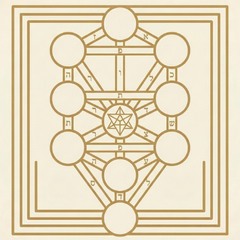
The Kabbalistic Tree of Life maps ten Sephiroth (qualities or emanations of consciousness) connected by 22 paths that correspond to the Major Arcana. The Tree functions simultaneously as a cosmological framework (how reality is organized) and a psychological one (how a person processes experience). Your numerological numbers place you on specific Sephiroth and linking paths.
The Tree reveals flow: not just which qualities are present, but how they relate and where they block. A person with strong placement in Chesed (expansion, generosity, abundance) but difficulty with Geburah (structure, limits, discernment) will often give without the capacity to set limits. That's structural, not a character flaw. Naming it structurally makes it workable. The 22 paths between Sephiroth show how different energies transition, or stall, in your particular configuration.
What integration produces
When five traditions land on the same theme independently, that convergence is worth taking seriously. Your Life Path number, your Saturn placement by house, your Vedic chart's dominant themes, and your tarot archetypes don't share assumptions or methodologies. When they all point toward, say, a recurring encounter with questions of authority and self-governance, the overlap isn't confirmation bias. It's five different measurement systems reaching the same conclusion about the same person.
Divergence carries its own information. When your Western chart suggests one psychological orientation and your Vedic chart suggests another, that's not a mistake in either system. It marks a real tension you're living. Integration doesn't resolve that tension for you. It makes it visible, named, and therefore workable. The most useful readings are often the ones where the systems disagree, because the disagreement maps the complexity you're actually navigating.
But the deepest layer is what lives between the traditions, not inside them. Your Tarot Soul Card and your Kabbalistic Sephirah placement don't just describe the same person from two angles. They describe two forces in specific relationship within you. When those forces are in tension, understanding the structure of that tension is more useful than any single portrait. The Integration Guide is built on exactly these intersections: it reads the relationships between the systems, not the systems in isolation. That's where something appears that no single tradition can reach.
Start with numerology. It's free.
Your name and birth date are enough. Takes three minutes to fill in.
Get your free numerology reading →